Methodology and Bias - Marcuson Inflation Survey: Q1 2024
We are delighted to launch this quarter’s survey, pulling together opinions on current inflation and its future outlook for the non-life insurance sector.
Click here to take part in the Q1 2024 inflation survey.
An interesting feature that emerged from our surveys last year was the impact of how the questions were framed. Participants may recall that we joined forces with the Institute and Faculty of Actuaries’ General Insurance Claims Inflation Working Party in Q3 last year. As a result, some of our questions were modified and threw up an interesting feature.
As many of you will be aware, there are two basic ways of thinking about claims inflation:
- An “All-at-Once” approach, where you estimate claims inflation directly; and
- A “Building Block” approach, where first you estimate CPI and then add modifiers to get to the class inflation associated with the class of business in question.
Our normal approach during 2023 had been to use the latter approach, however, when working with the Inflation Working Party, we switched to the former. This was to enable the working party to compare the survey results with those collated one year earlier.
It is always hard to draw firm conclusions with these types of exercises, not least because actual and anticipated inflation were changing during the course of 2023. But what seemed to emerge was that when framed as a Building Block question, respondents identified larger differences than when survey questions were framed using an All-at-Once formulation, and these differences had a greater tendency to be positive, i.e. when we asked the question this way, respondents were more likely to say claims inflation is higher than price inflation.
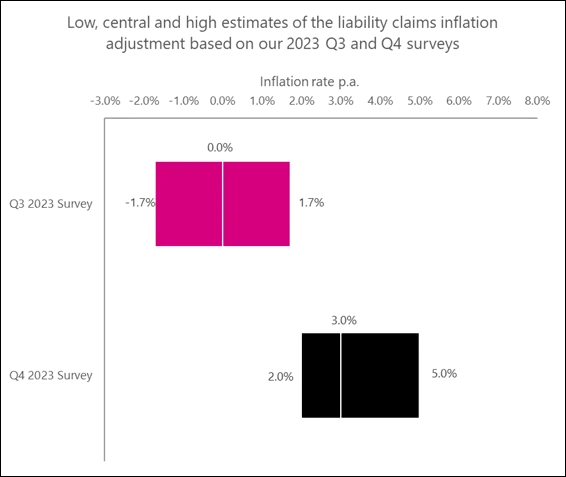
There is not necessarily a right or wrong answer to the methodology. To give just a couple of examples of the issues, a possible advantage of the building block approach is that it makes you think through the differences compared with price inflation, to consider what is driving inflation in the claims in question. But some would argue that it overly simplifies the relationship between the two, by ignoring lag and smoothing effects, and can bias respondents towards a number that is higher than price inflation. In this period where actuaries are continuing to grapple with the explicit adjustments needed, this suggests that firms need to consider how their reserve estimate strength may be subtly influenced by how they go about estimating claims inflation.
We haven’t asked your opinion on which is the better approach, but please do send us your thoughts on this, and other observations on the survey to survey@marcuson.co and we’d be delighted to hear from you.
Enjoy the survey!